
Robertson Stephens paid no fee to obtain recognition but has paid licensing fees to reference its appearances on the Newsweek, USA Today, and FA Magazine rankings lists. See Awards Disclosures

Executive Summary
Last week, stock prices were mixed, and bond prices were up (yields down). The MSCI EAFE (non-US developed) outperformed the S&P 500 and MSCI Emerging Markets indices. The best-performing sectors in the S&P 500 were consumer staples, energy, and health care. Across U.S. Russell style and market-cap indices, large-cap value performed best, and the high dividend factor led more broadly.
Last week felt risk-off in several ways. On the bond side, high-yield spreads widened while Treasury yields declined. In other words, higher-quality bonds outperformed lower-quality bonds. As for fixed income, the 10-year Treasury yield fell to 5.08% over the week, and the 2yr – 10yr Treasury yield spread flattened to +37 bps. The best-performing parts of the bond market were municipals and investment-grade corporates. High-yield bond spreads widened over 20bps to 331 bps over the week vs. approximately 500bps for the longer-term average. CCC spreads increased to more than 1,000 basis points, while the 10-year Treasury yield fell 16 basis points. The recent peak for the 10-year yield was just over 5.30%. It closed last week at 5.08%, down just over 20 basis points from that peak. High-quality bonds offer attractive yields and were inversely correlated with most stocks last week. That diversification benefit could be gaining investor interest if equities experience a more traditional risk-off event focused on a "growth shock" rather than concerns about an "inflation shock".
Key Takeaways
1. Inflation accelerated in September, driven by rising energy prices and continued underlying price pressures.
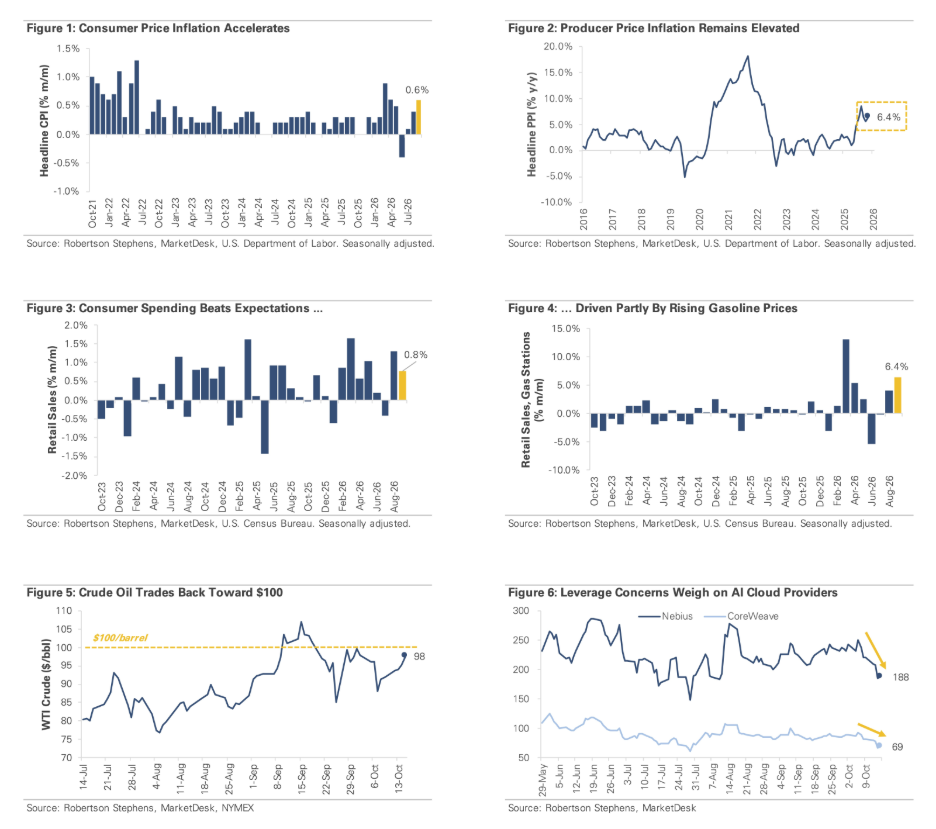
The Consumer Price Index (CPI) increased +0.6% for the month, with year-over-year inflation rising from +3.4% in August to +3.7%. Gasoline prices jumped +9.1% month-over-month, accounting for more than half the monthly increase. Underlying inflation also firmed, with core CPI, excluding food and energy, rising +0.3%, slightly above expectations. Separate data showed that producer prices increased +1.3% month-over-month in September, their largest monthly gain since March 2022, reflecting a combination of rising energy costs and broader price pressures. Implication – The combination of persistent inflation and slower hiring complicates the Federal Reserve's efforts to balance price stability with economic growth.
2. Consumer spending increased more than expected in September.
Retail sales rose +0.8% month-over-month, exceeding expectations for a +0.3% gain, with August's increase also revised higher to +1.3%. However, September's strength partly reflected higher gasoline prices. Because retail sales aren't adjusted for inflation, higher fuel prices can boost reported spending. This was particularly evident in September, when sales at gasoline stations increased +6.4%. Excluding spending at gas stations, retail sales increased +0.2%. Separately, spending at restaurants and other retailers remained positive, suggesting consumers continued making purchases despite higher costs. Implication – The report points to continued consumer spending, although growth outside gasoline stations was more modest than the headline suggested.
3. Investors are increasingly questioning the debt financing behind the AI infrastructure boom.
Shares of AI-related companies declined sharply this week as investors grew more concerned about the heavy borrowing used to fund AI infrastructure. CoreWeave, a major provider of AI computing capacity, fell roughly -15% on Wednesday as yields on some of its bonds approached 15%, a sign investors are demanding much higher compensation to lend to the company. Building AI infrastructure requires enormous upfront spending on data centers, specialized chips, and electricity, with some companies borrowing heavily to fund expansion. The sell-off occurred despite strong earnings from semiconductor manufacturers. Implication – Demand for AI computing and infrastructure remains strong, but higher borrowing costs have increased scrutiny of how companies are funding their infrastructure spending.
4. Major-bank earnings provided further evidence that the U.S. economy remains relatively resilient.
Third-quarter results showed continued growth in credit and debit card spending, providing additional evidence that consumers remained active. Credit quality also held up relatively well, with borrowers generally keeping up with their payments and loan losses remaining contained despite rising interest rates. Bank leaders described consumers and businesses as holding up well, while acknowledging challenges from inflation and higher borrowing costs. Implication – Taken together, the bank results suggest that consumers and businesses remain relatively resilient despite higher interest rates, elevated oil prices, and persistent inflation.